
The Philippines has been the default offshore destination for English-language support for two decades. What’s changed is how much else Filipino teams can now handle: Spanish, Mandarin, Japanese, Korean, French, German and Arabic queues are increasingly staffed from the same sites that run English. For a buyer trying to serve several markets without running several vendors, that’s the real story.
Here’s why the Philippines works for multilingual support, which languages you can realistically source there, and what to check before you commit a non-English queue to a Philippine partner.
Why Is the Philippines a Multilingual Powerhouse?
English proficiency you don’t have to manage around
English is an official language of the Philippines and the language of instruction in most schools, so it isn’t a second-language skill for the typical agent. The accent is neutral to North American ears, which is the practical reason Philippine call centers keep winning customer service work over destinations with cheaper labor: fewer repeats, fewer escalations, higher CSAT.
Clear communication is the baseline. Everything below builds on it.
Expanding language capabilities
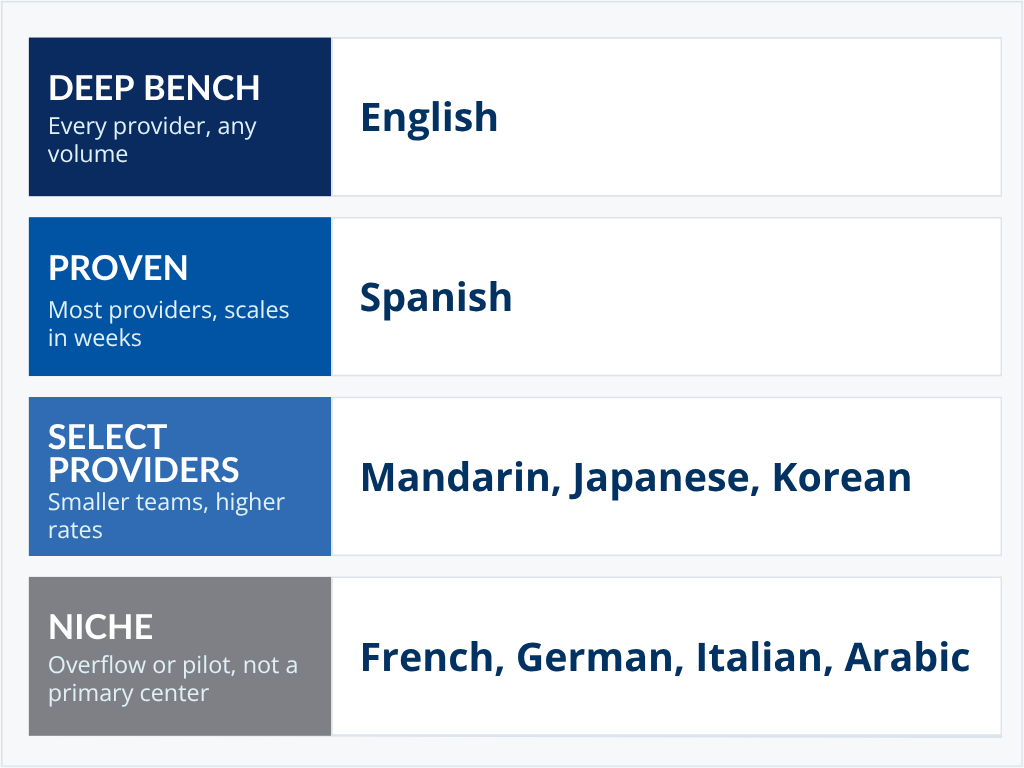
English still runs most Philippine call center seats, but non-English queues are no longer rare. Spanish is the easiest add, partly because Filipino carries a large Spanish vocabulary and partly because the labor pool already includes bilingual agents. Mandarin, Japanese and Korean have grown with demand from tech, ecommerce and APAC brands, and French and German queues exist at a smaller number of sites.
The practical effect is that a company can consolidate several language queues in one location, under one management team, instead of running a separate center per region.
Cultural alignment with Western markets
The country’s long ties with the United States mean Filipino agents pick up American idioms, references and service expectations quickly. That familiarity shows up as more natural conversations and fewer “the agent didn’t understand me” complaints, which is one reason Philippine sites tend to score well on customer satisfaction against other offshore options.
Technology adoption
Philippine BPOs have been early adopters of agent-assist tools, speech analytics and AI-supported quality monitoring, largely because their enterprise clients demand it. If your roadmap includes an AI-plus-human model, the Philippines is one of the easier places to run that hybrid at scale.
Cost and quality together
Companies moving support from North America or Western Europe to the Philippines typically save 30–50% on operating cost, and sometimes more once overhead is consolidated. The reason it’s a top destination rather than just a cheap one is that the savings don’t come with a quality trade-off on English-language work.
Which Languages Do Philippine Call Centers Support?
Beyond English, here’s what’s realistic to source in the Philippines today, and what each language is typically used for.
Spanish
The deepest non-English bench in the country. Used heavily for US Hispanic customer support and, at some sites, for Latin American markets. If you need one non-English language from the Philippines, Spanish is the safest bet.
Asian languages
- Mandarin Chinese: the most common Asian language queue, driven by tech and ecommerce clients.
- Japanese and Korean: available at a smaller set of providers, usually for regional brand support across APAC.
Expect these teams to be smaller and to command higher rates than English or Spanish. Native-speaker Japanese and Korean agents are a limited pool.
European languages
French, German and Italian queues exist but are niche. They work best for overflow, after-hours or lower-volume tier-1 support rather than as a primary center for a European market.
Arabic
An emerging segment. A handful of providers serve Middle Eastern brands and Arabic-speaking customers from Manila and Cebu. Treat it as a pilot, not a default.
Making multilingual support work
The buyers who get the most from a multilingual Philippine partner do four things before they sign:
- Map real language demand by market and channel, not by the languages the vendor lists.
- Rank languages by customer volume and revenue, and staff the top two or three properly rather than all of them thinly.
- Confirm how the provider recruits and retains non-English agents, and what happens when one resigns.
- Set quality standards per language, with native-speaker QA for anything beyond English and Spanish.
How Multilingual Philippine Call Centers Benefit Global Businesses
One location, several markets
Consolidating language queues in one country simplifies almost everything: one contract, one workforce management team, one QA program, one set of reports. Scaling into a new market becomes a hiring request rather than a site search.
Better customer satisfaction in non-English markets
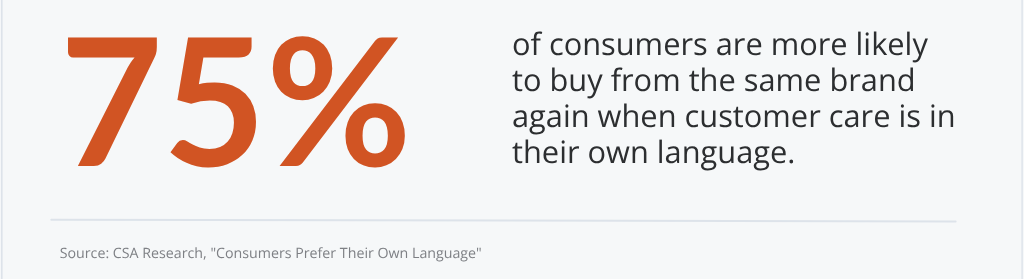
Language matters more than most support leaders assume. CSA Research found that 75% of consumers are more likely to buy again from a brand that offers customer care in their own language. Native-language support also resolves issues faster, because nothing gets lost in translation on either side of the call.
Faster scaling when demand shifts
Seasonal peaks, a product launch in a new country, a sudden rise in Spanish-speaking contacts: with a multilingual bench already in place, a provider can move agents between queues or ramp a new one in weeks rather than months. That flexibility is hard to replicate with separate regional centers.
Lower cost beyond labor
The labor arbitrage gets the attention, but consolidation cuts other costs too:
- Less overhead from running fewer sites and vendor relationships.
- Simpler onboarding and training, with one curriculum adapted per language.
- Cleaner reporting across languages, so you can compare CSAT and cost per contact on a like-for-like basis.
Final Thoughts About Offshore Multilingual Support
If your support footprint spans several languages and you’re still running a center per region, the Philippines is worth a serious look. English quality is the foundation, Spanish is a proven second language, and Mandarin, Japanese and Korean are available at the right providers. The trade-off is depth: the further you get from English and Spanish, the smaller the talent pool and the more carefully you need to vet the partner.
That vetting is the part buyers most often underestimate. Not every Philippine call center that lists a language can staff it well. If you want help finding providers with a proven bench in the languages you need, that’s what we do: start with our multilingual call center overview, or see our guide to outsourcing to the Philippines for costs and how to choose a partner.
FAQs About Multilingual Call Center Support in the Philippines
What languages are commonly supported in Philippine call centers?
English first, then Spanish. Mandarin, Japanese, Korean, French, German and Arabic are available at a smaller number of providers, usually in smaller teams.
Why are Filipino agents a good fit for Western markets?
Strong English, a neutral accent and long cultural familiarity with the United States, which makes conversations feel natural to North American customers.
How quickly can a Philippine call center add a new language?
Spanish can usually be ramped in weeks. Asian and European languages depend on the provider’s existing bench and can take longer, so ask for current headcount by language before you sign.
Are multilingual Philippine call centers cost-effective?
Yes. Savings of 30–50% against in-house North American or European teams are typical, with the biggest gains coming from consolidating several language queues at one site.
What should I check before moving a non-English queue to the Philippines?
Native-speaker headcount in that language, how the provider recruits and retains them, attrition in that team, and whether QA is done by native speakers.